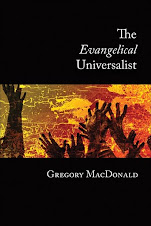
Gene Pineda and a few others will be will be opening a forum site dedicated to Christian Universalism. The website, when it goes live, will be.
www.evangelicaluniversalist.com
Gene would like to here from any interested in guidlines for the Forum.
One suggested list for a 'doctrinal basis' for the discussion group was the following:
1) Jesus Christ is the only incarnation of God
2) The teaching of the Trinity according to the Nicene Creed accurately interprets the Christian Bible
3) Christ is the only way to salvation
4. "The original manuscripts of the Bible are the canonical written Word of God and all of the teachings in the Bible are true."
5) Christ commands His followers to fulfill the Great Commission
6) Christ will gloriously return to earth
7) Christ redeems people from hell
It may be that there are some problems with this list so now is the time to add your bit.
Gene writes, "If no one is interested than I simply will not purchase the forum. But if people would like to have a more dedicated community then I'll give it a go."
So - do register your thoughts
Monday, August 25, 2008


Monday, August 18, 2008
How Universalism Has Impacted my Life
Denver raised a good point. He wrote:
"Your autobiographical sketch in TEU stops at your 'conversion' to universalism. How have you changed since believing in universalism? How has your relationship with God changed (especially since before your shift you found yourself unable to worship God)? How has it affected your daily life?"
Here are a few reflections off the top of my head.
It has impacted my understanding of God and thus also my prayer life and worship life. The vision of God and his purposes that I now hold is inspiring and makes me want to worship. The final paragraph of the book sums it up for me:
In conclusion, let me ask you to hold in your mind traditional Christian visions of the future, in which many, perhaps the majority of humanity, are excluded from salvation forever. Alongside that hold the universalist vision, in which God achieves his loving purpose of redeeming the whole creation. Which vision has the strongest view of divine love? Which story has the most powerful narrative of God’s victory over evil? Which picture lifts the atoning efficacy of the cross of Christ to the greatest heights? Which perspective best emphasizes the triumph of grace over sin? Which view most inspires worship and love of God bringing him honor and glory? Which has the most satisfactory understanding of divine wrath? Which narrative inspires hope in the human spirit? To my mind the answer to all these questions is clear, and that is why I am a Christian universalist.
This God is amazing! Exciting! Awesome! I have a stronger sense of his love, his soverignty, his purity, his integrity, his fidelity, his power to save, his grace, and his mercy than I had before. And I do not have doxological crises on the Hell issue now (though, being honest, I still have them for other reasons periodically, e.g., why God commanded the slaughter of the Canaanites).
It has increased my joy for the future. I find that when situations look bleak I can draw hope that history is the the hands of this omnibenevolent, omnipotent God with these good and cosmic purposes. I have a much stronger sense of the final victory of God and this takes the edge of the sometimes tragic events in life.
Oddly, the reality and importance of Hell impresses itself upon me more now than it did before I was a universalist. Perhaps because ECT was so very terrible I tried not to think about it and tended to sideline it in my theology (and my experience of lots of Christians is that they do the same). But I am now freed up to accept Hell and I feel that the church needs to recover the place of divine judgement in our theology and praxis. Ironic, huh?
I have found it to be pastorally helpful. Recently someone close to my family died after a painful and protracted illness. He was a wonderful man but not a believer and I was asked by his family to speak at his funeral. Before becoming a universalist I confess that if I was honest I would have thought his chances of being saved were very slim indeed. Just possibly he found faith in his final moments. Just possibly God might let him through (because judgement is in God's hands and not ours). But let's be honest, he had not accepted the gospel and that is that. He's missed his chance. That kind of message is little consolation to a grieving family. But my universalism allowed me to hold out solid hope of resurrection and salvation for him without in any way compromising the imperative of embracing the gospel message.
It has not impacted my evangelism in the sense that I do not present universalism to people when I explain the gospel. I do not have any formula for how I present the gospel (like the 4 spiritual laws) but I still address the sin issue and, when the situation is right, I speak of Hell and judgement. I do not tell people that Hell is not the end (though, if it was appropriate in a specific situation I would do so). Like Jesus and the prophets I would want the utter seriousness of the coming judgement to impact people and I would urge them to avoid it. The number of those saved in the end (i.e., all) is not part of the gospel message itself and some people might use it as an excuse not to take the warnings seriously. I am open to mentioning it but only in the right circumstances. So if you heard me explaining the gospel you may well not realize that I was a universalist.
Pax
Gregory
"Your autobiographical sketch in TEU stops at your 'conversion' to universalism. How have you changed since believing in universalism? How has your relationship with God changed (especially since before your shift you found yourself unable to worship God)? How has it affected your daily life?"
Here are a few reflections off the top of my head.
It has impacted my understanding of God and thus also my prayer life and worship life. The vision of God and his purposes that I now hold is inspiring and makes me want to worship. The final paragraph of the book sums it up for me:
In conclusion, let me ask you to hold in your mind traditional Christian visions of the future, in which many, perhaps the majority of humanity, are excluded from salvation forever. Alongside that hold the universalist vision, in which God achieves his loving purpose of redeeming the whole creation. Which vision has the strongest view of divine love? Which story has the most powerful narrative of God’s victory over evil? Which picture lifts the atoning efficacy of the cross of Christ to the greatest heights? Which perspective best emphasizes the triumph of grace over sin? Which view most inspires worship and love of God bringing him honor and glory? Which has the most satisfactory understanding of divine wrath? Which narrative inspires hope in the human spirit? To my mind the answer to all these questions is clear, and that is why I am a Christian universalist.
This God is amazing! Exciting! Awesome! I have a stronger sense of his love, his soverignty, his purity, his integrity, his fidelity, his power to save, his grace, and his mercy than I had before. And I do not have doxological crises on the Hell issue now (though, being honest, I still have them for other reasons periodically, e.g., why God commanded the slaughter of the Canaanites).
It has increased my joy for the future. I find that when situations look bleak I can draw hope that history is the the hands of this omnibenevolent, omnipotent God with these good and cosmic purposes. I have a much stronger sense of the final victory of God and this takes the edge of the sometimes tragic events in life.
Oddly, the reality and importance of Hell impresses itself upon me more now than it did before I was a universalist. Perhaps because ECT was so very terrible I tried not to think about it and tended to sideline it in my theology (and my experience of lots of Christians is that they do the same). But I am now freed up to accept Hell and I feel that the church needs to recover the place of divine judgement in our theology and praxis. Ironic, huh?
I have found it to be pastorally helpful. Recently someone close to my family died after a painful and protracted illness. He was a wonderful man but not a believer and I was asked by his family to speak at his funeral. Before becoming a universalist I confess that if I was honest I would have thought his chances of being saved were very slim indeed. Just possibly he found faith in his final moments. Just possibly God might let him through (because judgement is in God's hands and not ours). But let's be honest, he had not accepted the gospel and that is that. He's missed his chance. That kind of message is little consolation to a grieving family. But my universalism allowed me to hold out solid hope of resurrection and salvation for him without in any way compromising the imperative of embracing the gospel message.
It has not impacted my evangelism in the sense that I do not present universalism to people when I explain the gospel. I do not have any formula for how I present the gospel (like the 4 spiritual laws) but I still address the sin issue and, when the situation is right, I speak of Hell and judgement. I do not tell people that Hell is not the end (though, if it was appropriate in a specific situation I would do so). Like Jesus and the prophets I would want the utter seriousness of the coming judgement to impact people and I would urge them to avoid it. The number of those saved in the end (i.e., all) is not part of the gospel message itself and some people might use it as an excuse not to take the warnings seriously. I am open to mentioning it but only in the right circumstances. So if you heard me explaining the gospel you may well not realize that I was a universalist.
Pax
Gregory
Wednesday, August 6, 2008
N. T. Wright on Hell and Universalism
I thought that you might be interested in this insightful critique of Tom Wright's theology of Hell.
http://poserorprophet.livejournal.com/133982.html
Feel free to join the discussion. I hold Tom Wright in high regard so I'd be interested to know his response.
Gregory
http://poserorprophet.livejournal.com/133982.html
Feel free to join the discussion. I hold Tom Wright in high regard so I'd be interested to know his response.
Gregory
Tuesday, August 5, 2008
Universalism and Heresy in Sergius Bulgakov
I recently read an interesting article called "Universal Salvation in the Eschatology of Sergius Bulgakov" by Paul L. Gavrilyuk (JTS 57.1, April 2006). Bulgakov was an influential 20th C Orthodox priest and thinker. Here is an extract (and a footnote).
"As it is to be expected from an Eastern Orthodox priest and theologian, patristic tradition was a springboard for Bulgakov’s own theological deliberations. He observes in The Bride of the Lamb that in pondering the final destiny of humankind patristic tradition followed two distinct trajectories: one associated with the universalist ideas of Origen and Gregory of Nyssa, the other espoused by the opponents of the doctrine of universal salvation. It should be noted that Bulgakov’s knowledge of the relevant patristic material was largely based upon the dissertation of M. F. Oksiiuk, Eschatology of St Gregory of Nyssa (1914), which provided a comprehensive survey of patristic views on eschatology up to the time of the Fifth Ecumenical Council (553).
Bulgakov recognized that the claim that all, including the fallen angels, would ultimately be saved represented a minority opinion, suspect of heresy on the grounds of its association with Origen. At the same time the Russian theologian emphasized that the Church had not issued any dogmatic definition on the subject of the final outcome of the last judgment and the eternity of hell beyond what was stated in the Nicene creed. According to Bulgakov, in the absence of a conciliar definition, consensus patrum, even if it could be presumed to exist on this issue, was not enough to settle a dogmatic dispute. In an important article ‘Dogma and Dogmatics’ (1937), written concurrently with The Bride of the Lamb, Bulgakov argued that only the doctrine of the trinity enshrined in the creed and the doctrine of the incarnation stated in the definitions of the seven ecumenical councils enjoyed the status of the dogma binding upon all members of the Orthodox Church. He relegated all other doctrinal questions, such as the veneration of the Mother of God and of the saints, sacramental theology, pneumatology, atonement theories, and eschatology, to the sphere of theologoumena, that is, of more or less authoritative patristic opinions. Bulgakov stressed that in the area of eschatology in particular no ecumenical council had ever condemned Gregory of Nyssa’s version of universalism. It is a matter of historical fact that in the Eastern Orthodox tradition the doctrine of eternal damnation did not achieve the level of explicit articulation that it later found in the Roman Catholic conciliar definitions and Protestant confessions."
"As it is to be expected from an Eastern Orthodox priest and theologian, patristic tradition was a springboard for Bulgakov’s own theological deliberations. He observes in The Bride of the Lamb that in pondering the final destiny of humankind patristic tradition followed two distinct trajectories: one associated with the universalist ideas of Origen and Gregory of Nyssa, the other espoused by the opponents of the doctrine of universal salvation. It should be noted that Bulgakov’s knowledge of the relevant patristic material was largely based upon the dissertation of M. F. Oksiiuk, Eschatology of St Gregory of Nyssa (1914), which provided a comprehensive survey of patristic views on eschatology up to the time of the Fifth Ecumenical Council (553).
Bulgakov recognized that the claim that all, including the fallen angels, would ultimately be saved represented a minority opinion, suspect of heresy on the grounds of its association with Origen. At the same time the Russian theologian emphasized that the Church had not issued any dogmatic definition on the subject of the final outcome of the last judgment and the eternity of hell beyond what was stated in the Nicene creed. According to Bulgakov, in the absence of a conciliar definition, consensus patrum, even if it could be presumed to exist on this issue, was not enough to settle a dogmatic dispute. In an important article ‘Dogma and Dogmatics’ (1937), written concurrently with The Bride of the Lamb, Bulgakov argued that only the doctrine of the trinity enshrined in the creed and the doctrine of the incarnation stated in the definitions of the seven ecumenical councils enjoyed the status of the dogma binding upon all members of the Orthodox Church. He relegated all other doctrinal questions, such as the veneration of the Mother of God and of the saints, sacramental theology, pneumatology, atonement theories, and eschatology, to the sphere of theologoumena, that is, of more or less authoritative patristic opinions. Bulgakov stressed that in the area of eschatology in particular no ecumenical council had ever condemned Gregory of Nyssa’s version of universalism. It is a matter of historical fact that in the Eastern Orthodox tradition the doctrine of eternal damnation did not achieve the level of explicit articulation that it later found in the Roman Catholic conciliar definitions and Protestant confessions."
A version of the Origenist doctrine of apocatastasis was condemned by the local council of Constantinople in 543. Whether the bishops of the Fifth Ecumenical Council (553) anathematized this aspect of Origen’s theology explicitly is a murky question. Up to the late nineteenth century it was widely assumed that this ecumenical council did condemn universalism. See J. Daniélou, ‘L’apocatastase chez Saint Grégoire de Nysse’, Recherches de science religieuse 30 (1940), 328-47; Brian Daley, The Hope of the Early Church (Cambridge: Cambridge University Press, 1991), 190; J. Sachs, ‘Apocatastasis in Patristic Theology’, Theological Studies 54 (1993), 620-1.
Friday, August 1, 2008
The Evangelical Universalist Struck Dumb!
Dear Bloggerites,
Sorry that I have not been blogging recently. The simple fact is that I have something of a problem - Namely that I cannot think of anything to blog about.
Why is this? Well, by its very nature this is a single-issue blog dealing only with matters to do with universalism. I decided at the start not to repeat material from the book and therein lies my problem. You see most of my thoughts about universalism are already published in the book. If I am not going to repeat those then what am I to talk about? I don't actually have a lot left to say about universalism.
My fear is that I will just end up space-filling and not writing anything of value.
So I have decided that, unless I have a sudden rush of new thoughts on universalism (which is not likely as I do not have any time to do any new research), I will leave this blog open for another month for people to discuss and then I shall delete it.
Anyone is most welcome to contact me by email if they wish to chat about universalist issues.
Pax
Gregory MacDonald
Sorry that I have not been blogging recently. The simple fact is that I have something of a problem - Namely that I cannot think of anything to blog about.
Why is this? Well, by its very nature this is a single-issue blog dealing only with matters to do with universalism. I decided at the start not to repeat material from the book and therein lies my problem. You see most of my thoughts about universalism are already published in the book. If I am not going to repeat those then what am I to talk about? I don't actually have a lot left to say about universalism.
My fear is that I will just end up space-filling and not writing anything of value.
So I have decided that, unless I have a sudden rush of new thoughts on universalism (which is not likely as I do not have any time to do any new research), I will leave this blog open for another month for people to discuss and then I shall delete it.
Anyone is most welcome to contact me by email if they wish to chat about universalist issues.
Pax
Gregory MacDonald
Monday, July 21, 2008
Steve Hays Responds
It may interest some people that Steve Hays has responded to my four part response to him. In the interests of fairness you may wish to read it.
In summary: he still disagrees with me and still things I am a bad and dangerous person.
Oh dear. Never mind.
http://triablogue.blogspot.com/search?q=gregory+macdonald
I have already said that I will not be responding to it (not because I cannot but because I judge it to be fruitless). Readers must judge for themselves the merits of our respective arguments.
It simply remains to thank Steve for all the hours he has put into reading my book, and responding to it. It is an honor to be taken seriously, even if only in order to be 'refuted'.
I also thank Steve for making the book more widely known and inadvertantly communicating that its arguments warrant serious consideration. I hope that others follow his lead in reading and considering the case for universalism. Perhaps he has increased the sales a little. :-)
In summary: he still disagrees with me and still things I am a bad and dangerous person.
Oh dear. Never mind.
http://triablogue.blogspot.com/search?q=gregory+macdonald
I have already said that I will not be responding to it (not because I cannot but because I judge it to be fruitless). Readers must judge for themselves the merits of our respective arguments.
It simply remains to thank Steve for all the hours he has put into reading my book, and responding to it. It is an honor to be taken seriously, even if only in order to be 'refuted'.
I also thank Steve for making the book more widely known and inadvertantly communicating that its arguments warrant serious consideration. I hope that others follow his lead in reading and considering the case for universalism. Perhaps he has increased the sales a little. :-)
Thursday, July 17, 2008
The Trinity and why it is a big issue
Bobby asked me a really good question - Why do I think that the Trinity is such a big issue?
It was never my intention that this blog should be a forum for discussing such a topic but, given the fact that Unitarians have had an historic link with universalism, I guess it was inevitable.
To start, I think that it is important to point out that all the Christian thinkers who thrashed out the doctrine of the Trinity from 2nd to 5th centuries did not think that they were 'inventing' new truths or adding to revelation. They were simply seeking to find ways of doing justice to the divine self-revelation testified to in Scripture. They wanted to preserve the fine balances required to appreciate the God revealed in Christ. Indeed, for them the debate was never about abstract and irrelevant theological talk - though it may look that way to us at first glance - it was always about the God of the gospel.
I personally take the Christian tradition very seriously and in my view the fact that the ecumenical creeds have governed Christian belief in all three major streams of the Church for centuries gives them prima facie authority. As Christians we'd need very strong reasons to reject them. So I am not starting from a neutral place in this discussion.
Is the idea biblical? Some people never tire of pointing out that the word "Trinity" does not occur in the Bible. But that is simply irrelevant. If the concept is the best way of doing justice to biblical revelation then the Trinity is biblical even if the word is a later label used for convenience.
Where to start? I simply intend to make a few, simple and provisional remarks as the topic is VAST!
All the early Christians were good monotheistic Jews. For them there was one God and to worship any other deity was to commit the primal sin of idolatry. But here's the funny thing: As far as we can tell from the extant evidence the earliest Jewish followers of Jesus offered to their Messiah the worship due to God alone and they did not think that in so doing they were compromising their monotheism. (Richard Bauckham's book God Crucified and Larry Hurtado's book Lord Jesus Christ explore this issue at length).
Worship of Christ goes back to the earliest levels of the tradition that we can access. Given the robust monotheism of those who worshipped Jesus this is an extraordinary fact that needs accounting for. How could solid monotheistic Jews worship Jesus in good conscience?
In early Christian worship and theology Jesus was approached as the one though whom God made all created things (e.g., Jn 1:3; Col 1:16); the one who sits upon the very same throne as God (e.g. Rev 22:3); the one who receives the worship of God (e.g., Phil 2:10-11, note the allusion to Isa 45:23); as one who bears God's own name (Phil 2:9); as one who is even called "God"on occasion (e.g., Jn 20:28; Heb 1:8). Old Testament texts about YHWH are applied to Jesus (e.g., Isa 45:23 in Phil 2:10-11 or Ps 45:6-7 in Heb 1:8). Jesus' human body is the divine temple in which the very glory of God dwells (Jn 1:14). And so on and so forth. If Jesus did not participate in the identity of the one God of Israel then all this was idolatry.
And yet the early Christians were very clear that Jesus' identification with YHWH was not such that Jesus was identical with his Father in heaven. God (the Father) created all things through his Word (1 Cor 8:6 - which, incidentally, is a Christian expansion of the Jewish shema from Deut 6:4); the throne in heaven is "the throne of God and of the Lamb" (Rev 22:3); and when Jesus prayed to his Father in heaven he was not talking to himself.
So in the very earliest Christian responses to God in the light of the Christ-event we find a tension. Jesus shares in the identity of Israel's one God and yet is not identical with the Father. Trinitarian theology is the attempt to clarify this tension and to guard it again those who would deny the deity of Christ (Arianism) and those who would say that Jesus and the Father are the same 'Person' in different disguises (Modalism). It also guards against a whole range of other unbalancing theologies. The aim is not to explain God or to put God in a box and understand him. God is mysterious - and this assertion is not an attempt to dodge hard philosophical issues but a simple admission that God's bigger than our little brains. The aim of the systematic formulations of Trinitarian theology is to protect certain fundamental Christian claims about God and the gospel from being lost. It is to preserve the delecate balances of the divine self-revelation.
A similar process took place with the Holy Spirit after the controversies over the person of Christ had died down. Perhaps people might like to pick that up in conversations (this blog does not wish to outstay its welcome).
But it is not just a matter about how to interpret certain texts. Issues surrounding the deity of Christ had theological import.
All of the Father's interaction with the universe - from creation through to new creation - is mediated through the Son and in the Spirit. If Son and Spirit are creatures (even highly exalted creatures) then God has no direct contact with his universe at all. God disappears off into the distance leaving us to engage with super-beings (the Son and the Spirit) instead. But Trinitarian theology, by insisting that Son and Spirit participate in the identity of the one God, puts God right at the heart of all creative and redemptive action. When Christ is saving us from sin God is saving us from sin. When Christ is with us God is with us. When the Spirit draws us through Christ to the Father God is drawing us through God to God. It's God all the way down.
Of course, please do not think I underplay the humanity of Christ - it is simply that this post is not on that issue. Christ is able to fully save us because he is divine but he is able to save us because he is fully human and can represent humanity.
Universalism does not require Trinitarian theology (it does not even require theistic theology). Christian universalism, I think, does. I know that in saying this I will anger a whole load of blog readers. Oh well. I'm getting used to upsetting people.
It was never my intention that this blog should be a forum for discussing such a topic but, given the fact that Unitarians have had an historic link with universalism, I guess it was inevitable.
To start, I think that it is important to point out that all the Christian thinkers who thrashed out the doctrine of the Trinity from 2nd to 5th centuries did not think that they were 'inventing' new truths or adding to revelation. They were simply seeking to find ways of doing justice to the divine self-revelation testified to in Scripture. They wanted to preserve the fine balances required to appreciate the God revealed in Christ. Indeed, for them the debate was never about abstract and irrelevant theological talk - though it may look that way to us at first glance - it was always about the God of the gospel.
I personally take the Christian tradition very seriously and in my view the fact that the ecumenical creeds have governed Christian belief in all three major streams of the Church for centuries gives them prima facie authority. As Christians we'd need very strong reasons to reject them. So I am not starting from a neutral place in this discussion.
Is the idea biblical? Some people never tire of pointing out that the word "Trinity" does not occur in the Bible. But that is simply irrelevant. If the concept is the best way of doing justice to biblical revelation then the Trinity is biblical even if the word is a later label used for convenience.
Where to start? I simply intend to make a few, simple and provisional remarks as the topic is VAST!
All the early Christians were good monotheistic Jews. For them there was one God and to worship any other deity was to commit the primal sin of idolatry. But here's the funny thing: As far as we can tell from the extant evidence the earliest Jewish followers of Jesus offered to their Messiah the worship due to God alone and they did not think that in so doing they were compromising their monotheism. (Richard Bauckham's book God Crucified and Larry Hurtado's book Lord Jesus Christ explore this issue at length).
Worship of Christ goes back to the earliest levels of the tradition that we can access. Given the robust monotheism of those who worshipped Jesus this is an extraordinary fact that needs accounting for. How could solid monotheistic Jews worship Jesus in good conscience?
In early Christian worship and theology Jesus was approached as the one though whom God made all created things (e.g., Jn 1:3; Col 1:16); the one who sits upon the very same throne as God (e.g. Rev 22:3); the one who receives the worship of God (e.g., Phil 2:10-11, note the allusion to Isa 45:23); as one who bears God's own name (Phil 2:9); as one who is even called "God"on occasion (e.g., Jn 20:28; Heb 1:8). Old Testament texts about YHWH are applied to Jesus (e.g., Isa 45:23 in Phil 2:10-11 or Ps 45:6-7 in Heb 1:8). Jesus' human body is the divine temple in which the very glory of God dwells (Jn 1:14). And so on and so forth. If Jesus did not participate in the identity of the one God of Israel then all this was idolatry.
And yet the early Christians were very clear that Jesus' identification with YHWH was not such that Jesus was identical with his Father in heaven. God (the Father) created all things through his Word (1 Cor 8:6 - which, incidentally, is a Christian expansion of the Jewish shema from Deut 6:4); the throne in heaven is "the throne of God and of the Lamb" (Rev 22:3); and when Jesus prayed to his Father in heaven he was not talking to himself.
So in the very earliest Christian responses to God in the light of the Christ-event we find a tension. Jesus shares in the identity of Israel's one God and yet is not identical with the Father. Trinitarian theology is the attempt to clarify this tension and to guard it again those who would deny the deity of Christ (Arianism) and those who would say that Jesus and the Father are the same 'Person' in different disguises (Modalism). It also guards against a whole range of other unbalancing theologies. The aim is not to explain God or to put God in a box and understand him. God is mysterious - and this assertion is not an attempt to dodge hard philosophical issues but a simple admission that God's bigger than our little brains. The aim of the systematic formulations of Trinitarian theology is to protect certain fundamental Christian claims about God and the gospel from being lost. It is to preserve the delecate balances of the divine self-revelation.
A similar process took place with the Holy Spirit after the controversies over the person of Christ had died down. Perhaps people might like to pick that up in conversations (this blog does not wish to outstay its welcome).
But it is not just a matter about how to interpret certain texts. Issues surrounding the deity of Christ had theological import.
All of the Father's interaction with the universe - from creation through to new creation - is mediated through the Son and in the Spirit. If Son and Spirit are creatures (even highly exalted creatures) then God has no direct contact with his universe at all. God disappears off into the distance leaving us to engage with super-beings (the Son and the Spirit) instead. But Trinitarian theology, by insisting that Son and Spirit participate in the identity of the one God, puts God right at the heart of all creative and redemptive action. When Christ is saving us from sin God is saving us from sin. When Christ is with us God is with us. When the Spirit draws us through Christ to the Father God is drawing us through God to God. It's God all the way down.
Of course, please do not think I underplay the humanity of Christ - it is simply that this post is not on that issue. Christ is able to fully save us because he is divine but he is able to save us because he is fully human and can represent humanity.
Universalism does not require Trinitarian theology (it does not even require theistic theology). Christian universalism, I think, does. I know that in saying this I will anger a whole load of blog readers. Oh well. I'm getting used to upsetting people.
Subscribe to:
Posts (Atom)